Over mij
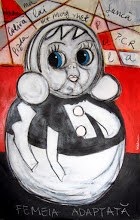
- ZOE D. COCHIA
- Nederlands – Roemeens kunstenares, geboren in Boekarest. Een vrije rebelse geest die experimenteert met fotografie, collages, schilderijen, film en poëzie. Onverwachte associaties geven haar werk een bijna barok accent waar de pijn van verlies doorheen trekt. Zij bedient zich van een krachtige vormentaal waarin details soms door hun aarzeling een poëtisch moment oproepen. Na haar studie voor werktuigbouwkundig ingenieur en een eerste baan voor de Roemeense spoorwegen verliet zij na de revolutie van 1989 het land om zich in Nederland te vestigen. Hier begon een periode van overleven door alle mogelijke baantjes aan te pakken. Tegelijkertijd schrijft zij poëzie en korte verhalen. In haar gedichten komt haar vrije en associatieve geest sterk naar voren, het is exuberant werk, wars van de Nederlandse voorzichtigheid. Zij laat het aan de lezer om een eigen interpretatie te geven aan de werelden die zij in talige beelden oproept.
What one perceives is a result of interplays between past experiences, one’s culture and the interpretation of the perceived. If the percept does not have support in any of these perceptual bases it is unlikely to rise above perceptual threshold.
Perception gives rise to two types of consciousness; phenomenal and psychological. The difference everybody can demonstrate to himself/herself by simple opening and closing his/her eyes. Phenomenal consciousness is full of rich sensations that are hardly present when eyes are closed. Psychological consciousness is well researched and measured. It occurs half a second after a stimulus starts. If a weak stimulus lasts less, it is unlikely to be perceived. The capacity of psychological consciousness is also well measured. Depending on methods used the capacity ranges between seven and forty symbols or percepts at one time.

Perception is one of the oldest fields in psychology. The oldest quantitative law in psychology is the Weber-Fechner law, which quantifies the relationship between the intensity of physical stimuli and their perceptual effects. It was the study of perception that gave rise to the Gestalt school of psychology, with its emphasis on holistic approach.

Perception and reality
In the case of visual perception, some people can actually see the percept shift in their mind's eye. Others who are not picture thinkers, may not necessarily perceive the 'shape-shifting' as their world changes. The 'esemplastic' nature has been shown by experiment: an ambiguous image has multiple interpretations on the perceptual level.
Just as one object can give rise to multiple percepts, so an object may fail to give rise to any percept at all: if the percept has no grounding in a person's experience, the person may literally not perceive it.
The processes of perception routinely alter what humans see. When people view something with a preconceived idea about it, they tend to take those preconceived ideas and see them whether or not they are there. This problem stems from the fact that humans are unable to understand new information, without the inherent bias of their previous knowledge. The extent of a person’s knowledge creates their reality as much as the truth, because the human mind can only contemplate that which it has been exposed to. When objects are viewed without understanding, the mind will try to reach for something that it already recognizes, in order to process what it is viewing. That which most closely relates to the unfamiliar from our past experiences, makes up what we see when we look at things that we don’t comprehend.
This confusing ambiguity of perception is exploited in human technologies such as camouflage, and also in biological mimicry, for example by Peacock butterflies, whose wings bear eye markings that birds respond to as though they were the eyes of a dangerous predator. Perceptual ambiguity is not restricted to vision. For example, recent touch perception research (Robles-De-La-Torre & Hayward 2001) found that kinesthesia-based haptic perception strongly relies on the forces experienced during touch. This makes it possible to produce illusory touch percepts (see also the MIT Technology Review article The Cutting Edge of Haptics).
Cognitive theories of perception assume there is a poverty of stimulus. This (with reference to perception) is the claim that sensations are, by themselves, unable to provide a unique description of the world. Sensations require 'enriching', which is the role of the mental model. A different type of theory is the perceptual ecology approach of James J. Gibson. Gibson rejected the assumption of a poverty of stimulus by rejecting the notion that perception is based in sensations. Instead, he investigated what information is actually presented to the perceptual systems. He (and the psychologists who work within this paradigm) detailed how the world could be specified to a mobile, exploring organism via the lawful projection of information about the world into energy arrays. Specification is a 1:1 mapping of some aspect of the world into a perceptual array; given such a mapping, no enrichment is required and perception is direct.

Perception-in-action
The ecological understanding of perception advanced from Gibson's early work is perception-in-action, the notion that perception is a requisite property of animate action, without perception action would not be guided and without action perception would be pointless. Animate actions require perceiving and moving together. In a sense, "perception and movement are two sides of the same coin, the coin is action." A mathematical theory of perception-in-action has been devised and investigated in many forms of controlled movement by many different species of organism, General Tau Theory. According to this theory, tau information, or time-to-goal information is the fundamental 'percept' in perception.

Types of perception
- a.) Amodal perception
- b.) Color perception
- c.) Depth perception
- d.) Visual perception
- c.) Form perception
- e.) Haptic perception
- f.) Speech perception
- h.) Perception as Interpretation
- i.) Numeric Value of Perception
- j.) Pitch perception
- k.) Harmonic perception
- l.) Rhythmic perception
dinsdag 23 september 2008

Belevenis RUHR gebied
Onbewust naam ik het boek “De onzictbare steden” van Italo Calvino mee zonder in de gaten te hebben hoe inspirerend woorden, een urbanistische omgeving kunnen visualiseren in de fantasie van mens waarbij de stad als synoniem staat voor het collectieve geheugen en het menselijke brein met zijn netwerk.
Het idee is om de ingebakken monotone verveling van de bewoners van Essen te confronteren met hun eigen routes die ze elke dag opnieuw pendelen of bewandelen en voor hun nieuwe innerlijke tijdsgebonden routes te creëren als verbeeldingen van hun eigen bestaan op een kunstzinnige manier in een industriële omgeving.
Juist door lopende, denkende trajecten te ontwerpen willen we dat men meer bewust wordt van het term vergankelijkheid. Het paradoxale van dit concept is de statische waarde van een industrieel gebouw dat door het projecteren van een ambulante massa gesplitst in individuen opeens een emotionele verkoopwaarde krijgt.
Achter de “onvriendelijke” coulissen van de opgestapelde stenen van een fabriek, verschuilen zich veel onzichtbare verhalen die het hart van de stad vormen “pompend, bloedend, producerend, maar ook provocerend”
Het labyrint van een fabriek vormt in onze ogen een route die een mens moet durven ervaren, vooral in deze tijd van kaders, hekken, en waarin “degenen die een verborgen en avontuurlijk leven te veel ongemakken hebben te verduren”. Ze zijn de katten, de clowns, de dieven, de verboden minnaars en alleen zij nemen nog de hogere en meest ongangbare wegen: ze springen van dak tot dak, laten zich zakken van plaatjes op daklijsten, balanceren over goten met koorddanserpassen.
Dit beeld gaan we verwezenlijken met een tragi-humoristische werpende blik op de maatschappij waarin de esthetiek van de architectuur te weinig humane karakter heeft. Ook erotica is een deel van de menselijke aarde, en die willen we volop gebruiken op een burleske manier.
Het menselijke gaat in het concept ook gepaard met de basiselementen van de natuur, vooral het water als organische bouwsteen van leven. Daarbij zullen we ook gebruik van geluiden kunnen maken.